Tuatara Week, #3:
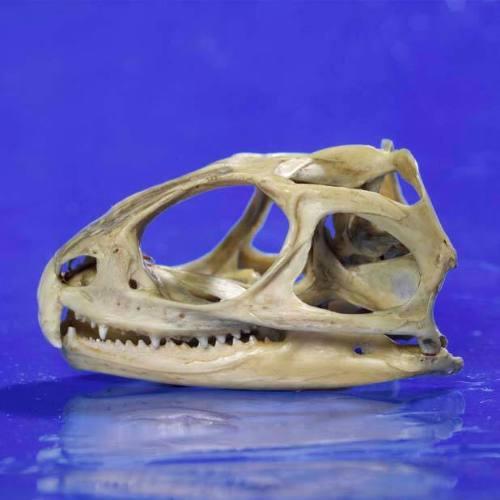
The tuatara has very, very strange teeth, completely unlike those of any other reptile. Their jaw anatomy (aside from the rows of teeth) is more like a beak than a typical mouth - the large protrusions in the front that resembles a rodent's incisors are actually an extension of its premaxillary bone. No other reptile has anything like it, and this is actually an example of a tuatara trait that is distinctively *not* primitive. It is specific to rhynchocephalians (the name literally means "beak head"), and is an adaptation the order developed considerably after they and the rest of the reptile family tree diverged.
The rest of the teeth are, however, primitive - and are quite unlike those of other reptiles. Turtles don't have teeth at all, crocodilians have socketed teeth similar to those of mammals, and most lizards and snakes have teeth attached to the surface within a groove in the jaw (incidentally, it is likely this precise groove that laid the groundwork for later venom delivery mechanisms). Both crocodilians and (most) lizards can replace their teeth throughout life; if a tooth is damaged a new one simply grows out.
Tuatara teeth are simply sharp protrusions of the jawbone that jut through the gums. They do have enamel and some other features of true teeth, but they're an *incredibly* simple setup, which they have inherited directly from so ancient ancestors that they're our ancestors too.
Tuataras have added another trick of their own, though: They have *two* rows of upper teeth, that the lower teeth fit between. When they bite down on prey, they slide the lower jaw back and forth, with an action similar to a saw or a bread knife.