

Blog post: Where are we going? https://bigzaphod.com/blog/where-are-we-going/
I should blog more often probably.
Although maybe after reading this, perhaps I shouldn't blog more.
Hmm.
Discussion
Blog post: Where are we going? https://bigzaphod.com/blog/where-are-we-going/
I should blog more often probably.
Although maybe after reading this, perhaps I shouldn't blog more.
Hmm.
@bigzaphod Good post. Keep blogging. Also, I like your minimalist site theme.
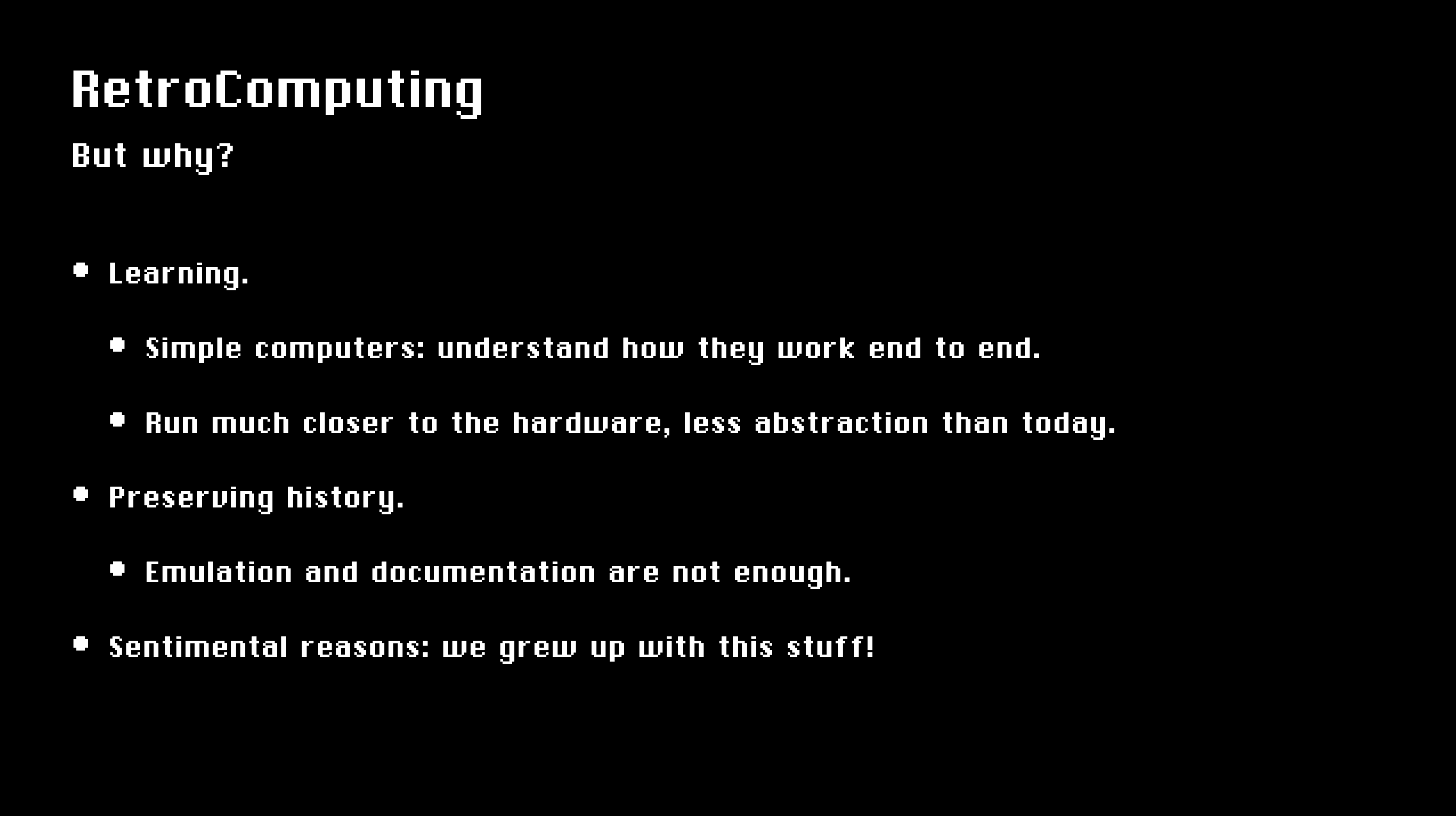
@bigzaphod Fully agree! Made a brown bag about MacDVI (my DVI/HDMI adaptor for Mac Plus TTL video) in Daily Job and started with this slide about why doing retro-computing.
The first reason is exactly that: if you want to learn how all this stuff works, you need something simple. Nobody can understand an entire machine these days, but back then, one could. It was within the capacity of a single human (if you abstracted physics at some level, of course).
(Yes, I used that font on all slides.)





@bigzaphod I fully agree with the latter points. The brittleness of it all is mind-boggling, to the point of being anxiety-inducing. The foundation we have is from the 90s, everything written in unsafe programming languages, except all the poorly thought-out specs and standards, when the entire software engineering discipline was still in its infancy. And as if someone decided 'eh, it's good enough', everyone stopped rewriting, rethinking, reinventing. We only piled more and more code on top, to hide all the ugliness beneath layers and layers of abstraction. Just like the sshole vulnerability recently, this is what happens when the stack is treated as a Jenga tower: no one dares to touch it, change it, no matter how arbitrary the state of it is. Instead we're forced to do the only realistic thing anyone can do, piling even more on top. However, I disagree with the former points. There has never been a better time to dig deep and wide into any detail. LLMs let you explore almost at the speed of thought. But it's a double-edged sword. Most people seem to use LLMs to generate heaps of new code, piling it on, rarely stopping to ask if they should, and often not even reading the output. This guarantees that no human will ever know how this next layer of cruft really works. These people advocate for ignorance over understanding, after all.