

🕯️ Ukraine.
Holodomor
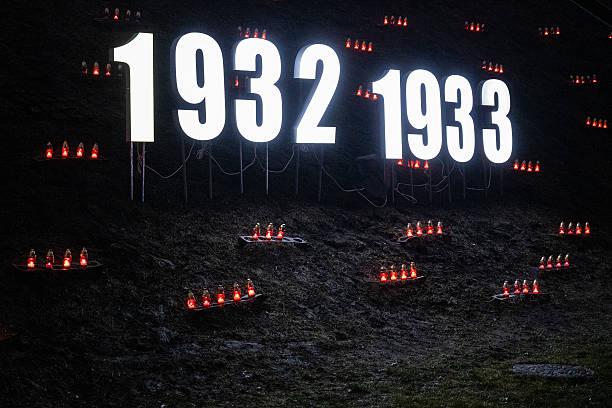
The Russia communist government imposed excessive grain procurement quotas on Ukraine in 1932-1933, resulting in the starvation and deaths of millions of people.
These actions were recognized as genocide against the Ukrainian people in 2006 in Ukraine , Germany, France, Great Britain, Australia, Georgia, Estonia, Canada, Brazil, Colombia, Latvia, Lithuania, Mexico, Poland, the United States, Hungary, and Switzerland. (Photo by Danylo Antoniuk/Anadolu via Getty Images)
2 Boosts
0 Likes
3/?
🕯️ It was organised by the Communist regime in Moscow with the intent of committing the mass extermination of Ukrainians. This strategy aimed to destroy their national identity and eliminate the foundations of a distinct Ukrainian nation. The ultimate goal of the Holodomor, as a deliberate policy by the Kremlin, was to secure Ukraine as an integral part of the USSR permanently and transform (Russify) Ukrainians under the guise of creating a “single Soviet people.”
👇
4/?
The authorities acknowledged that the preservation of Ukrainians’ distinct identity and consciousness opened the possibility of restoring Ukrainian independence and allowing Ukraine to withdraw from the Union. The Holodomor aimed to eliminate even the slightest possibility of events unfolding
👇
5/?
In December 1917, the Russian Communist regime launched a war of aggression against the Ukrainian People’s Republic (UPR), established by Ukrainians following the fall of the Tsarist regime. To conceal their aggressive actions, the Bolsheviks established the Communist Party (Bolsheviks) of Ukraine (CP(b)U), and then, in its name, proclaimed the puppet Ukrainian Socialist Soviet Republic (UkrSSR). This pseudo-state was a sham; its nominal leaders were appointed from Moscow.
👇
6/?
The Ukrainian armed forces and partisan units continued to resist the occupiers until November 1921. However, the forces were unequal, and the Russian Communists succeeded in occupying most of Ukraine. In December 1922, the puppet Ukrainian Soviet Socialist Republic was incorporated into the USSR.
👇
7/?
To win the population’s trust, the Bolsheviks implemented a policy of ‘Ukrainisation’ in 1923. However, the rapid development of Ukrainian culture, including literature, the press, theatre and cinema, turned out to be an unexpected side effect of Ukrainisation. Joseph Stalin realised that the situation had become dangerous, as Ukrainian quasi-statehood could take on real substance.
👇
8/?
The spread of communist ideology was inextricably linked to aggressive atheist propaganda. Seeking to eliminate religion from all spheres of life, the Bolsheviks persecuted ‘representatives of religion’. By 1931, the Communists had closed 80% of rural churches in Ukraine.
👇
9/?
In December 1927, the USSR proclaimed a policy of collectivisation: the merging of private farms into state-owned collective farms. Late 1929 and early 1930 marked the beginning of what was known as total collectivisation. Each farmer received a specific number of “trudodni” (meaning “labour days”) for their work on the collective farm and got payments in kind. However, labour payments were so low that they left farmers unable to feed themselves and their families.
👇
10/?
Therefore, farmers were forcibly driven into collective farms through a campaign of terror and propaganda against their opponents, whom the regime labelled ‘kurkuls’, ‘bourgeois nationalists’ and ‘counter-revolutionaries’. The punishment for the so-called ‘kulaks,’ who were sometimes branded as such solely because of their political views, was deportation from their villages to barren lands or to the north of the USSR.
👇
11/?
The authorities confiscated property and handed it over to the collective farms or to the village poor.
Historians have recorded around 4,000 mass protests by peasants in the early 1930s against collectivisation, taxation policies, looting, terror and violence.
👇
12/?
Realising the potential danger posed by a popular uprising, the Communist regime resorted to radical measures. Between 1932 and 1933, almost all the grain grown by Ukrainian farmers was confiscated.
In some regions of Ukraine, farmers were deprived of 80 per cent of their harvested grain. The grain procurement plans established for Ukraine were economically unrealistic, as were the fines for failing to fulfil them.
👇
13/?
Starving people searched the fields for ears of grain, or other produce left behind after the harvest. However, on 7 August 1932, the government decree was issued, known as the ‘law on five ears of grain’. Under this decree, the property of collective farms was classified as state-owned. Consequently, picking even a few ears of grain from a collective farm’s field was considered “theft of state property”, punishable by execution or 10 years’ imprisonment with confiscation of property.
👇
14/?
The practical implementation of these genocidal plans was carried out by the Chairman of the Council of Ministers of the USSR, Vyacheslav Molotov; the Secretary of the Central Committee of the All-Union Communist Party (Bolsheviks), Lazar Kaganovich; and the leaders of the party and state apparatus of the Ukrainian SSR: Pavlo Postyshev, Stanislav Kosior, Vlas Chubar and Mendel Khataievych.
👇
15/?
The next genocidal measure was the introduction of fines in kind: the state’s right to seize from farmers not only grain but also other foodstuffs and property that could be sold or exchanged for food.
👇
16/?
Individual villages that failed to meet grain procurement plans or resisted the USSR policy were placed on the so-called ‘black boards’. This meant implementing a special punishment regime: villages or even entire districts were surrounded by troops or special units, and all food supplies were completely confiscated from their inhabitants.
17/?
Having deliberately created a situation in which Ukrainians began dying en masse from starvation, the Soviet authorities took measures to prevent them from travelling to those regions of the USSR where there was no famine. In particular, on 27 December 1932, a resolution was adopted by the Central Executive Committee and the Council of People’s Commissars of the USSR “On the establishment of a unified passport system throughout the USSR and the compulsory registration of passports”.
👇

#Ukraine #Holodomor
🕯️
The 1932-33 famine took place as harvests dwindled and Soviet leader Josef Stalin's police enforced the brutal policy of collectivising agriculture by requisitioning grain and other foodstuffs.
AFP PHOTO/ SERGEI SUPINSKY (Photo by Sergei SUPINSKY / AFP) (Photo by SERGEI SUPINSKY/AFP via Getty Images)