

🕯️ Ukraine.
Holodomor
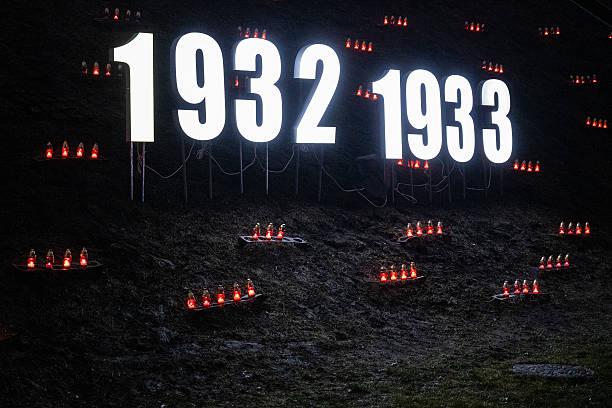
The Russia communist government imposed excessive grain procurement quotas on Ukraine in 1932-1933, resulting in the starvation and deaths of millions of people.
These actions were recognized as genocide against the Ukrainian people in 2006 in Ukraine , Germany, France, Great Britain, Australia, Georgia, Estonia, Canada, Brazil, Colombia, Latvia, Lithuania, Mexico, Poland, the United States, Hungary, and Switzerland. (Photo by Danylo Antoniuk/Anadolu via Getty Images)
2 Boosts
0 Likes
3/?
🕯️ It was organised by the Communist regime in Moscow with the intent of committing the mass extermination of Ukrainians. This strategy aimed to destroy their national identity and eliminate the foundations of a distinct Ukrainian nation. The ultimate goal of the Holodomor, as a deliberate policy by the Kremlin, was to secure Ukraine as an integral part of the USSR permanently and transform (Russify) Ukrainians under the guise of creating a “single Soviet people.”
👇
4/?
The authorities acknowledged that the preservation of Ukrainians’ distinct identity and consciousness opened the possibility of restoring Ukrainian independence and allowing Ukraine to withdraw from the Union. The Holodomor aimed to eliminate even the slightest possibility of events unfolding
👇
5/?
In December 1917, the Russian Communist regime launched a war of aggression against the Ukrainian People’s Republic (UPR), established by Ukrainians following the fall of the Tsarist regime. To conceal their aggressive actions, the Bolsheviks established the Communist Party (Bolsheviks) of Ukraine (CP(b)U), and then, in its name, proclaimed the puppet Ukrainian Socialist Soviet Republic (UkrSSR). This pseudo-state was a sham; its nominal leaders were appointed from Moscow.
👇
6/?
The Ukrainian armed forces and partisan units continued to resist the occupiers until November 1921. However, the forces were unequal, and the Russian Communists succeeded in occupying most of Ukraine. In December 1922, the puppet Ukrainian Soviet Socialist Republic was incorporated into the USSR.
👇
7/?
To win the population’s trust, the Bolsheviks implemented a policy of ‘Ukrainisation’ in 1923. However, the rapid development of Ukrainian culture, including literature, the press, theatre and cinema, turned out to be an unexpected side effect of Ukrainisation. Joseph Stalin realised that the situation had become dangerous, as Ukrainian quasi-statehood could take on real substance.
👇
8/?
The spread of communist ideology was inextricably linked to aggressive atheist propaganda. Seeking to eliminate religion from all spheres of life, the Bolsheviks persecuted ‘representatives of religion’. By 1931, the Communists had closed 80% of rural churches in Ukraine.
👇

#Ukraine #Holodomor
🕯️
The 1932-33 famine took place as harvests dwindled and Soviet leader Josef Stalin's police enforced the brutal policy of collectivising agriculture by requisitioning grain and other foodstuffs.
AFP PHOTO/ SERGEI SUPINSKY (Photo by Sergei SUPINSKY / AFP) (Photo by SERGEI SUPINSKY/AFP via Getty Images)