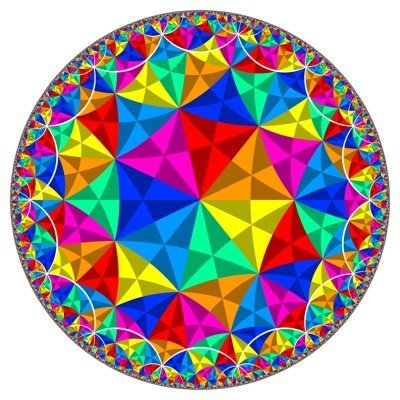

I love the Gauss-Bonnet theorem!
The most famous and elegant version of this says that if you integrate the Gaussian curvature, K, across a surface without a boundary, like a sphere or a torus, you get:
∫∫ K dA = 2πχ
where χ is the Euler characteristic, a topological invariant of the surface. This can be found from the formula
χ = V - E + F
where V, E, F are the number of vertices, edges and faces in a subdivision of the surface, such as a triangulation. For any sphere, χ = 2, and for the standard sphere of radius R we have K = 1/R^2 everywhere, so this is the same as stating that the surface area of the sphere is 4πR^2.
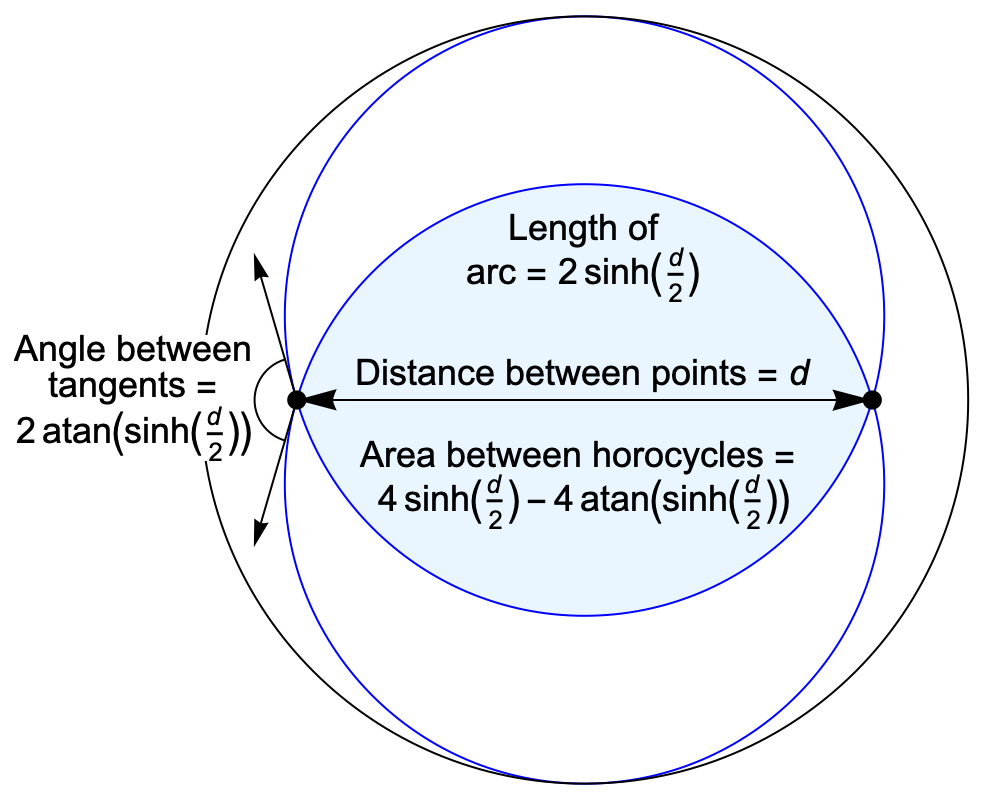
But we can also use the Gauss-Bonnet theorem on regions of surfaces with boundaries. To give a simple example, suppose you have a polygon-like region in the hyperbolic plane, where K = -1 everywhere, and suppose the perimeter has a constant geodesic curvature of k. The perimeter of a circle of radius R in the hyperbolic plane has constant k = coth(R), and the limiting circle as R→∞, known as a horocycle, has k = 1.
The “digon” illustrated has two arcs of horocycles as its perimeter.
The Gauss-Bonnet theorem tells us that:
K × (area of region) +
k × (length of perimeter of region)
= 2π – Σ (exterior angles at corners)
For K = -1, k = 1, this lets you find the area of the digon:
Area = (length of perimeter) - 2π + Σ (exterior angles at corners)
= 2 (length of one arc) - 2π + 2 (π - angle between tangents)
= 4 sinh(d/2) - 4 atan(sinh(d/2))
It's also possible to compute the area by a brute force integration ... but this is much, much easier!