


tante
boosted


RE: https://fedi.copyleft.org/@bkuhn/117453005618069047
slopware freedom conservancy 🥱
Discussion
These are the people building the Fediverse!
RE: https://fedi.copyleft.org/@bkuhn/117453005618069047
slopware freedom conservancy 🥱
@cwebber Is this whole free software endeavor about producing more and faster, or is it about empowering people and fostering collectives?
This is the question those LLMs companies have forced us to answer, thereby breaking the alignment that existed so far between industry & “open source” on one hand, and people focusing and user freedom and autonomy.
@bkuhn while we have seen hype cycles, the AI bubble is something fundamentally different. The pessimism and anger is based on a lot more than that it gets shoved into everything.
And we shed them as soon as it became practical to do so.
You will never find it practical to shed Claude, because:
1. you will never be able to afford the necessary hardware to do so (Moore's law is dead),
2. you will never obtain an adequate corpus of training data (because you, lacking billions of dollars, are actually subject to copyright), and
3. you will be prohibited by law to do so (because compliance with AI regulations costs billions).
This is an attempt to address the growing number of "oh, so you don't like automation when it comes for *you*? checkmate, programmers" articles out there, but there's so much more to say. Overall I think this idea that computer programmers just destroyed jobs is largely false. One of the weird corollaries of the Productivity Paradox is that we mostly *did* expand possibilities and make things better and more fun.
(Until all the Gig Economy stuff. But that's still a minority of tech history.)
Also this is a big argument in the alternative. For technical reasons related to context limits and training data, none of this shit actually works well enough to replace software at any meaningful scale. To paraphrase @pluralistic by way of Jensen Huang: AI will not take your job. A boss using AI to fake their quarterly KPIs will take your job.
AI does not disrupt. AI entrenches. AI turns money into more money; AI turns investment into dependency. We are living in a funhouse mirror of that right now where the combination of overly-plausible demos and first-one's-free incentives are swamping the actual balance-sheet math. But the economics require that this stabilize, that the capital flows reverse direction. The wave has come in and we are just starting to feel the undertow.
Linus is saying the quiet part out loud: AI-native projects are environments where the key ingredient is _capital_. Abstraction can be performed by a quiet appreciation. True automation can be disruptive.
AI-based architectures (again, assuming that the AI works reliably, which is a highly contingent proposition) translate all that stuff into capital flows. A "machine speed" project requires _money_ to participate in, regardless of their complexity.
Abstraction is leverage. Automation is the amplification of power. Abstraction is democratization. Automation repeats a duplicative process so you can stop thinking about it and focus on something higher level. Abstraction elides so architecture can expand.
AI is anti-leverage. Where an abstraction will elide duplication with semantic compression, AI steamrolls the duplication by copying and pasting faster than a human can.
It's also very frustrating to constantly have my opposition to AI be taken as an opposition to abstraction, or to automation, and a desire to do every little thing by hand. But it's the opposite. For a whole bunch of reasons, AI anti-abstracts. It adversarially creates oceans of duplication to process. It creates a situation where the AI user gets to set the terms of some ecosystem with synthetic productivity but then everyone else needs an AI to figure out what's going on in that new ecosystem.
@fentiger This is an interesting idea, but mainline DHT is not compatible with overlay networks like Tor and I2P, AFAIK
I am looking for a DID method that is not tied to any particular transport or network. The most promising is still did:webvh, which supports witnesses:
The extra participants are intended to identify both malicious attackers of the identifier, and malicious use of the identifier by the DID Controller.
 Posted in
Technical Discussion
@fentiger This is an interesting idea, but mainline DHT is not compatible with overlay networks like Tor and I2P, AFAIK
I am looking for a DID method that is not tied to any particular transport or network. The most promising is still did:webvh, which supports witnesses:
The extra participants are intended to identify both malicious attackers of the identifier, and malicious use of the identifier by the DID Controller.
Posted in
Technical Discussion
@fentiger This is an interesting idea, but mainline DHT is not compatible with overlay networks like Tor and I2P, AFAIK
I am looking for a DID method that is not tied to any particular transport or network. The most promising is still did:webvh, which supports witnesses:
The extra participants are intended to identify both malicious attackers of the identifier, and malicious use of the identifier by the DID Controller.
"AI code generators are like compilers for translating natural language into a programming language" – I have heard and read this unfitting analogy quite a few times already.
It is misleading, as it sweeps a crucial technical point under the carpet and downplays some of the more serious consequences for people who have to deal with AI-generated code.
Compilers are deterministic, usually generating functionally equivalent code for a given input program on every run, according to language specifications.
Programmers usually do not have to check the machine code or the assembly code a native compiler generates, as its behavior is well-specified and, with mature compilers, also well-tested.
Programmers can expect the compiler to "just work", transforming code that is comparatively easy to read and write for humans into a form that is simpler for the machine to process, but difficult to read for humans.
Also, assuming the input code is written in a standardized language and uses its features in a well-defined way, switching compilers is relatively easy.
Yes, AI code generators also transform something that is easier to read – in this case natural language – into something that is simpler for the machine to process – in this case program code.
However, this is where the similarity ends.
The path from given prompt input to output code is practically inscrutable, warranting a lot more skepticism about the result.
In the general case, can you expect to get functionally equivalent code with the same prompts every time? No!
Can you even expect correct output? No!
What if you switch the model? Well, have fun!
Furthermore, as natural language is often imprecise and ambiguous, AI code generation cannot be as reliable as an actual compilation process – it is inherently probabilistic.
At the same time, the resulting software is used by actual humans with real consequences to them, so somebody has to accept the responsibility for that code, including actually reviewing and testing it.
Combine this with the ability of these code generators to quickly spew out tons of code from just a few short prompts.
Now we have a code review bottleneck:
Can we review tons of machine code a compiler generates? No, but we don't have to.
Can we review tons of AI-generated code? Also no, but we have to anyway.
Now you understand why some project maintainers become increasingly frustrated.
PS, before anyone complains: Yes, I do know about surprising optimizations, differences between compilers, compiler bugs, profile-guided optimization, the trusting-trust issue and so on, believe me.
Every abstraction comes with some flexibility of how it is implemented and also a risk of implementation bugs.
This post is not about these rare, special-case issues.
Additionally, just because I have focused on one particular problem with AI code generation, this does not mean that I think this is the only one.
all true, and i agree. but with properly orchestrated ai code reviews, using several top models reviewing each other’s work and going back and forth, you can largely reduce human review to checking the intent rather than every line of code. the resulting implementation these days can be extremely good, often better than what most humans produce.
YouTube
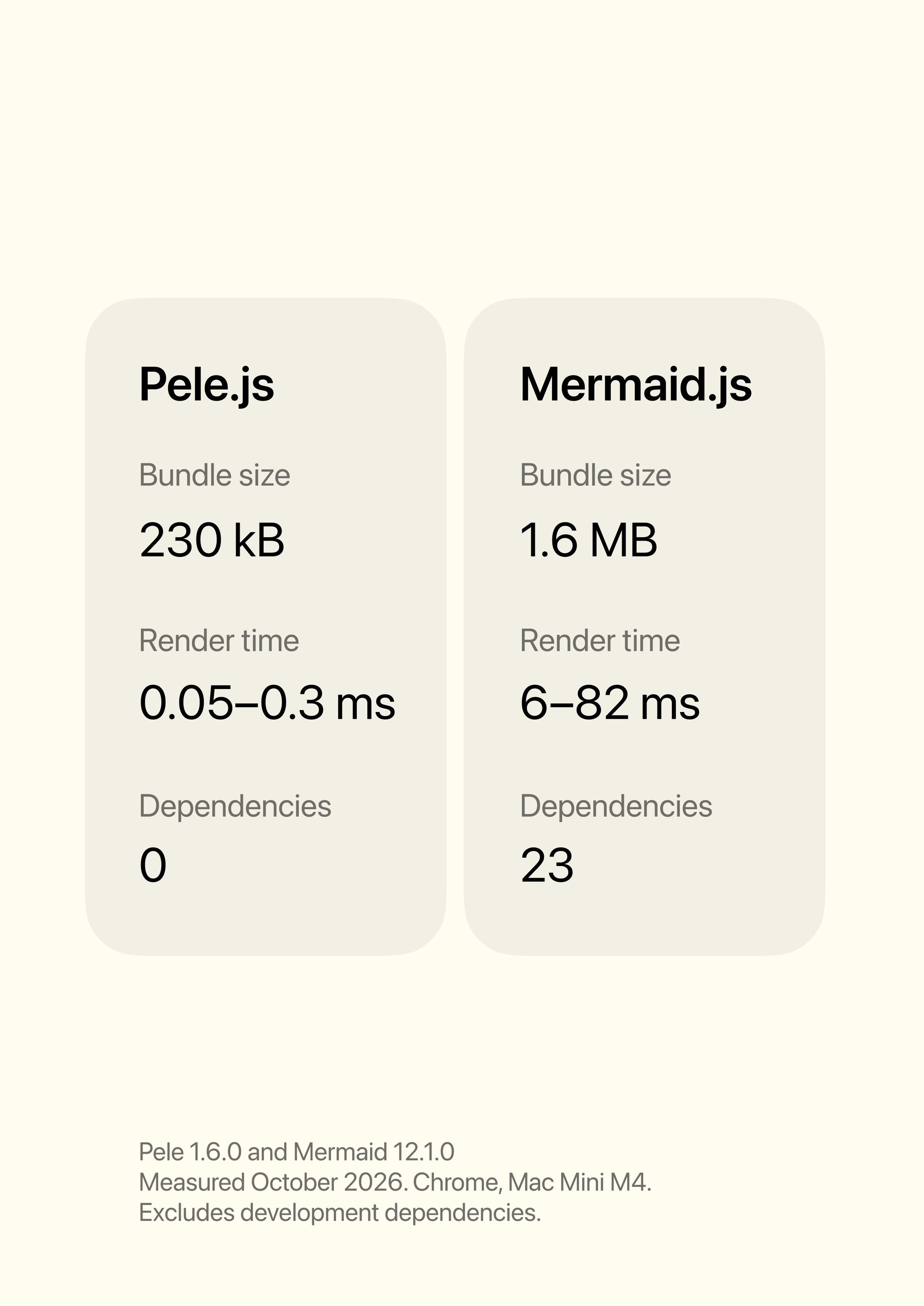
This is Pele, my new rendering library for diagrams and charts, compatible with the latest Mermaid syntax.
- 100-500× faster than mermaid.js
- 6× smaller bundle
- No dependencies
- Easy to theme
- Responsive to device width
In pursuit of making #Obsidian insanely fast and cohesively designed, I always found the Mermaid library to be too big, too slow, and too hard to theme. Pele will be the new renderer in the next version of Obsidian, but you can start using it now!
@gabboman@gabboman.xyz @Fasgort@owo.cafe
ya aunque lo que te he dicho en discord es "¿no se puede ver de alguna manera que el post de bsky está disponible solo para usuarios logueados?" (para no hacer cita sino captura)
@Fasgort@owo.cafe @minka@plaza.minkalia.city
he de decir que el usuario ha elegido eso por su privacidad y y y
pero es un poco mas complejo, mirare a ver
Time to change your password? Type "passwd" and follow the prompts.
-- Dru <genesis@istar.ca>
#NLnet Foundation and #NGIZero awarded grants to 47 #projects in the twelfth open call of the NGI Zero Commons Fund. Supported by the #EuropeanCommission and #SERI, projects span #hardware, #softwareengineering, #infrastructure and #applications to advance #digitalsovereignty. https://www.apc.org/en/news/47-open-source-projects-receive-nlnet-grants-boost-digital-autonomy?Fedizen.EU #Fedizen #Fediverse #ActivityPub #News

Install Fedizen
Get the full app experience