

The Fermi Paradox (and the associated background material) makes up my favourite set of lectures. Everything else is terrible, but DANG I'm going to enjoy my teaching this week.
2 Boosts
0 Likes
I've done a thread on this before, but I'm going to do it again because it's so wild.
The Fermi Paradox is just the simple question: if there are billions of stars that are billions of years older than our Sun, and life is common, and "intelligent" life happens once in a while, WHERE IS EVERYBODY?
One possible solution: We are alone.
We can't rule this out, Earth is the only place in the Universe that we know for sure has life. It is possible that we are the very first "intelligent civilization" that has ever arisen in the Universe.
Of course, in astronomy, the distances and numbers are so vast that any explanation that involves being "just happening to be lucky enough to observe something" is immediately suspect.
(Of course, we're here, so this is the mother of all observation biases)
Maybe interstellar travel is just too hard. Nothing alive can do it. (But then why don't we see any probes?)
Maybe the "drive to explore" is a uniquely human quality, and other aliens wouldn't have this.
(I see multiple problems with this suggestion, including requiring us to be unique and special again.)
And then there's the most depressing possibility: self-destruction. Maybe every "intelligent civilization" runs into the environmental destruction/energy usage problems and purposeful destruction (war) that we are facing today. Do civilizations ever survive long enough to travel to other stars?
Then it gets weird: what if there IS a galactic civilization, but they just won't talk to us, or haven't noticed us. This is the premise of a large fraction of all science fiction, perhaps because this is the most hopeful option presented by most textbooks.
But I have more!
What if successful civilizations realize their planetary boundaries, don't overshoot them, and thus become undetectable. That's the idea proposed by Wong & Bartlett, one of the papers I make my students read because it's REALLY interesting (shorter version available here): https://studio.m-anage.com/agu/abscicon21/meetingapp.cgi/Paper/1028592
The basic idea is that "a sufficiently advanced civilization is indistinguishable from Nature"
I like this a lot.



@sundogplanets Sadly Octopi, who are hugely intelligent, never know their parents because their evolution which gives them intelligence also decrees they live for one breeding season, then die. So each one goes through self-learning in a very short time, then perishes.
I see us in the same way, we're currently very short lived and there's not enough time for each generation to learn enough to really move the needle, and we're forced to spend that time paying bills.





@sundogplanets
your voice transcription app botched "fermented pair of ducks"
* the Italian campfire recipe is out-of-this-world
This federated comment is not yet available here.

@mycotropic @sumisu @sundogplanets
I did not refer to the radio bubble. Just "there is life on that planet".

@sundogplanets There is an "Encyclopedia Galactica" with Earth as an entry, and a "prime directive" type agreement to only observe us using covert means.


@sundogplanets
This is my theory:
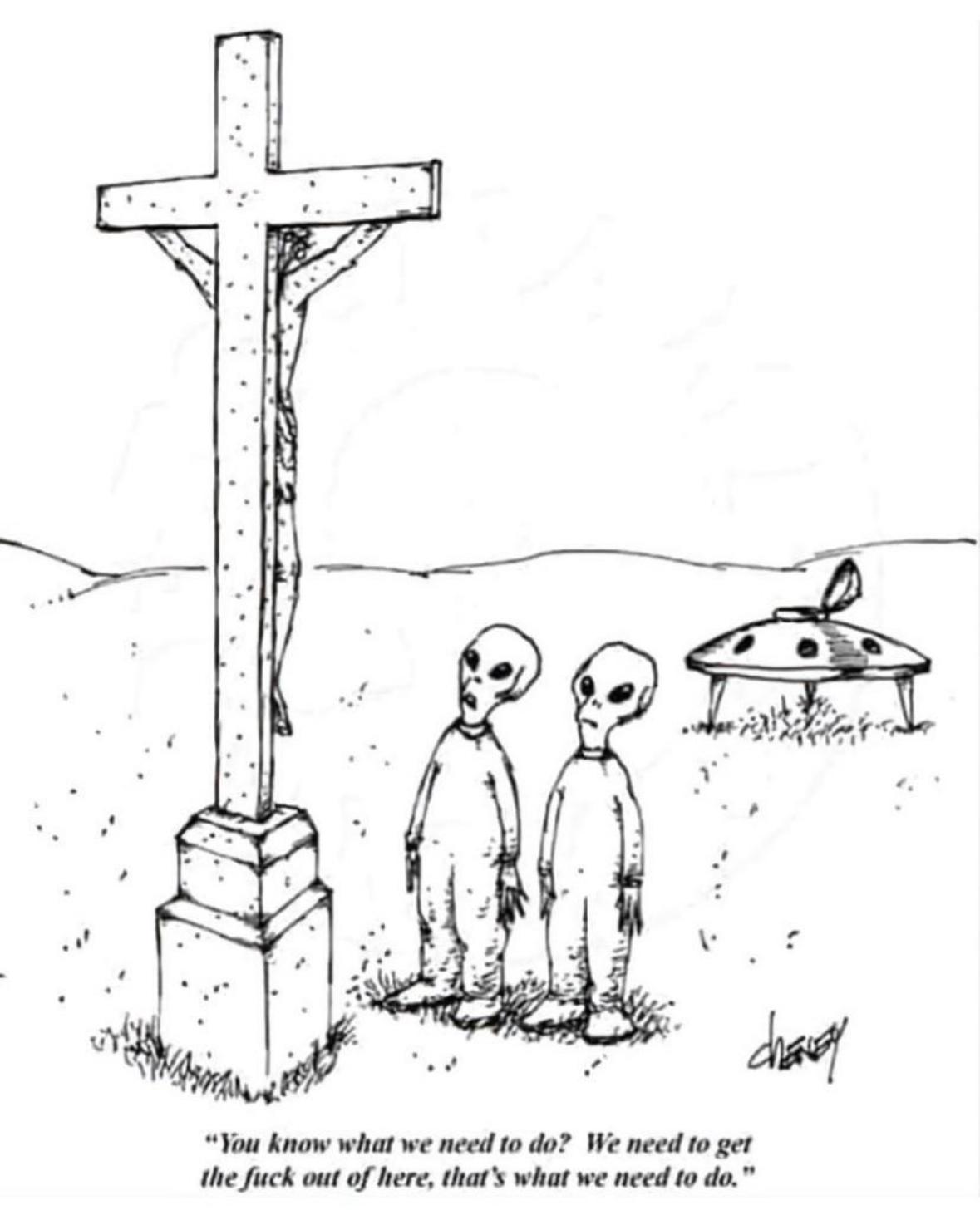

Also I think explaining the Fermi Paradox and possible solutions makes the very best campfire story possible. Fight me. (Or better yet, invite me to your campfire!)