

The Fermi Paradox (and the associated background material) makes up my favourite set of lectures. Everything else is terrible, but DANG I'm going to enjoy my teaching this week.
3 Boosts
0 Likes
I've done a thread on this before, but I'm going to do it again because it's so wild.
The Fermi Paradox is just the simple question: if there are billions of stars that are billions of years older than our Sun, and life is common, and "intelligent" life happens once in a while, WHERE IS EVERYBODY?
One possible solution: We are alone.
We can't rule this out, Earth is the only place in the Universe that we know for sure has life. It is possible that we are the very first "intelligent civilization" that has ever arisen in the Universe.
Of course, in astronomy, the distances and numbers are so vast that any explanation that involves being "just happening to be lucky enough to observe something" is immediately suspect.
(Of course, we're here, so this is the mother of all observation biases)
Maybe interstellar travel is just too hard. Nothing alive can do it. (But then why don't we see any probes?)
Maybe the "drive to explore" is a uniquely human quality, and other aliens wouldn't have this.
(I see multiple problems with this suggestion, including requiring us to be unique and special again.)
And then there's the most depressing possibility: self-destruction. Maybe every "intelligent civilization" runs into the environmental destruction/energy usage problems and purposeful destruction (war) that we are facing today. Do civilizations ever survive long enough to travel to other stars?


Self-destruction is looking increasingly likely. Nuclear war, global warming, AI, out of control capitalism. Perhaps it's the thing that makes us stronger that will kill us.
But it's also possible that we retreat into virtual worlds that are much easier to explore, and lose interest in the real universe with its annoying lack of FTL travel.


Jill Tarter has developed the concept of SETI as a "cosmic mirror", where humans imagine aliens as we imagine ourselves.
So in the Cold War, both American and Soviet astronomers imagined aliens as being destroyed by nuclear war.
And more recently, people imagine aliens as being destroyed by climate change.
@sundogplanets Just want to point out that if we are actually alone there is no Fermi Paradox.
There are three viable conditions for things. None, the thing doesn't exist. One, the thing is unique. Many, if there is more than one, there really have to be many. So, the Fermi Paradox is predicated on many, but one is a perfectly reasonable answer and it eliminates any paradox.





@sundogplanets
your voice transcription app botched "fermented pair of ducks"
* the Italian campfire recipe is out-of-this-world
This federated comment is not yet available here.
@mycotropic @sumisu @sundogplanets
I did not refer to the radio bubble. Just "there is life on that planet".

@sundogplanets There is an "Encyclopedia Galactica" with Earth as an entry, and a "prime directive" type agreement to only observe us using covert means.


@sundogplanets
This is my theory:
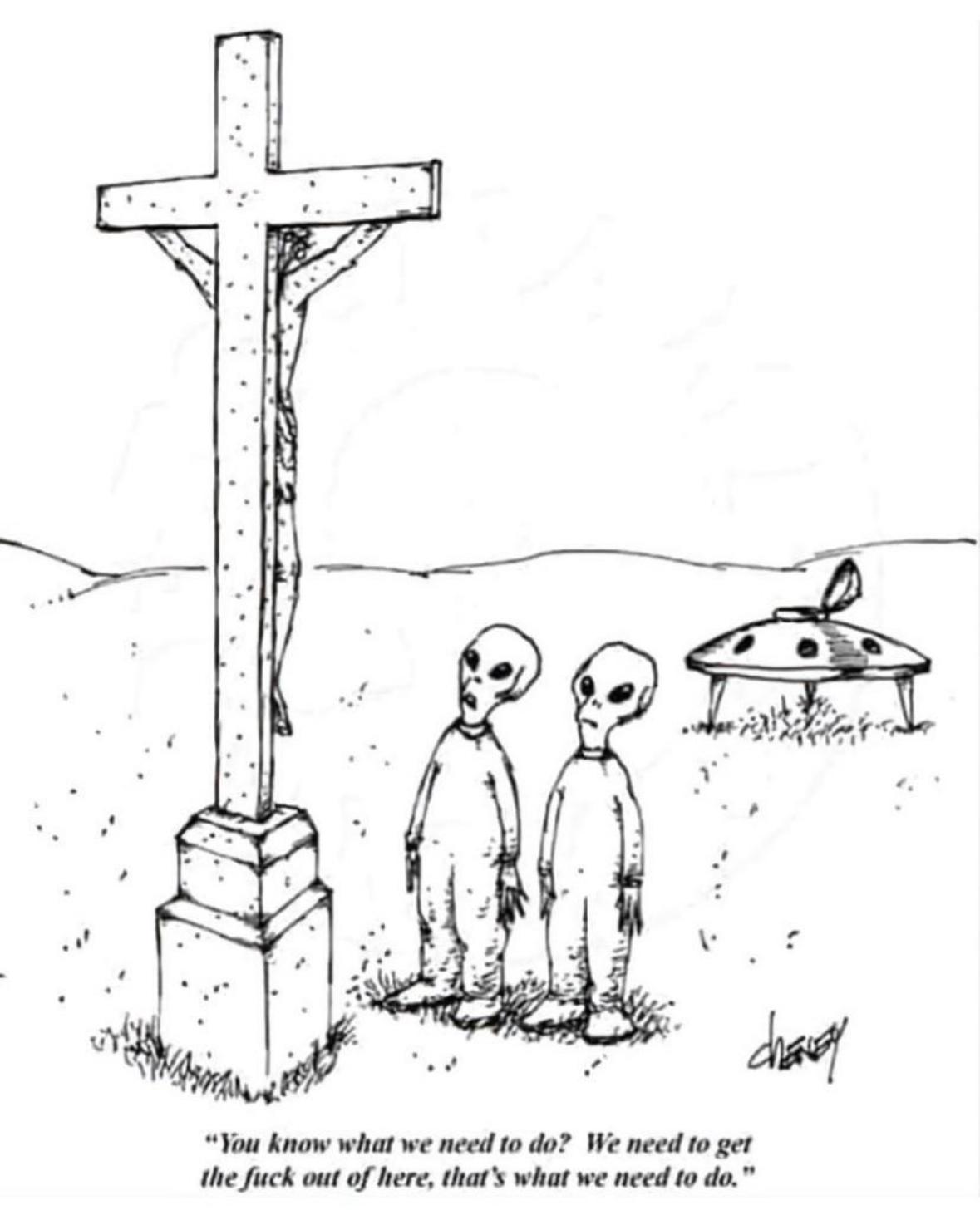


@sundogplanets I'm fascinated with this paradox as well. My dad was a devoted Catholic, and one of the clearest memories I have as a kid w/ my relatives came one summer evening on the lawn chairs out under the stars, listening to my dad and his brothers argue about whether the existence of life on other planets somehow threatened the foundations of the Christian faith. My father, an Air Force engineer who worked on several aerospace design projects, was convinced it was diametrically opposed, and I remember thinking that was bonkers then and I still do.
The Catholic Church recently celebrated the feast of Christ the King, in which Jesus is often cast as the King of the Universe. To me, it's always seemed downright blasphemous and highly uncharitable to suggest that a Divine Creator would be so stingy with such an unknowably vast canvas. It's also always struck me as incredible that so many people are so certain about so much, even though we still actually know so very little.
@briankrebs There's that quote from the book/movie Contact that's something like "Seems like an awful waste of space." I just cannot look up at the trillions of galaxies each with billions of stars and believe that we are alone.
Because I teach at a Catholic school (as a non-Catholic), I really hope someday I get to co-teach a class about aliens/astrobiology/astronomy with one of the priests. Seems like that would be a super interesting learning experience!
@sundogplanets I'm sure it has come up in your discussions on this topic already, but having finally finished the Three Body Problem trilogy, it seems to be a literary answer to the question posed by the Fermi Paradox. The answer seems to be "they're all hiding."


@briankrebs @sundogplanets I suspect that this is the cold war retaining a sweetheart airbase deal in my mind; but I love berzerker probes as a solution.

@briankrebs @sundogplanets They are hiding because qe are made of meat.


@briankrebs @sundogplanets Also a similar idea in Greg Bear’s “The Forge of God”

@briankrebs @sundogplanets Ideally, we will learn definitively what the Catholic take is, by the Pope ruling ex cathedra shortly *after* we find indisputable evidence (e.g., microbial life) "elsewhere". If you just define terms from Genesis ("firmament", "sea", etc) in a way that includes non-terrestrial bodies, it's easy. Admittedly it gets very dicey if we find life as advanced as us, but different - a space-faring octopus, say. Then the whole "in His image" needs a re-look.

One of Alastair Reynolds' books had a sub-plot that involved Andromeda disappearing. The reason for this turned out to be that the machine people wanted to create a wormhole there, and this solved the causality problem: no information could flow from one end of the wormhole to the other in normal space.
I'd idly pondered something similar as a premise for a novel that I never got around to writing: if you can solve the causality problems with faster-than-light travel by ensuring that there is no slower-than-light way for information to flow between two places, then you could encase two star systems in some opaque barrier and have fast travel between them. If the barriers allowed gravity to propagate then there's a load of mass hidden away behind barriers. So the solution to the Fermi Paradox and dark matter is the same: dark matter is connected civilisations and the probes are everywhere, they just don't wake up and offer to connect your civilisation until you reach a threshold that we haven't hit yet.

@sundogplanets one of my main gripes with most religious texts is that they all seem to sell the creator of this universe incredibly short. I also feel that science and religion have no good reason to be at odds with one another as science is merely the process of observing and understanding of God’s creation.


This is a fascinating topic to me as well. I think one of the most interesting Christian takes on the subject (though Anglican, not Catholic) is C. S. Lewis's. He wrote a fairly concise essay about it ("Religion and Rocketry") and also addresses it throughout his Space Trilogy (which is sci-fi deeply informed by medieval cosmology). In short, he didn't think the existence of extraterrestrial life would necessarily conflict with Christianity at all!

Also I think explaining the Fermi Paradox and possible solutions makes the very best campfire story possible. Fight me. (Or better yet, invite me to your campfire!)