

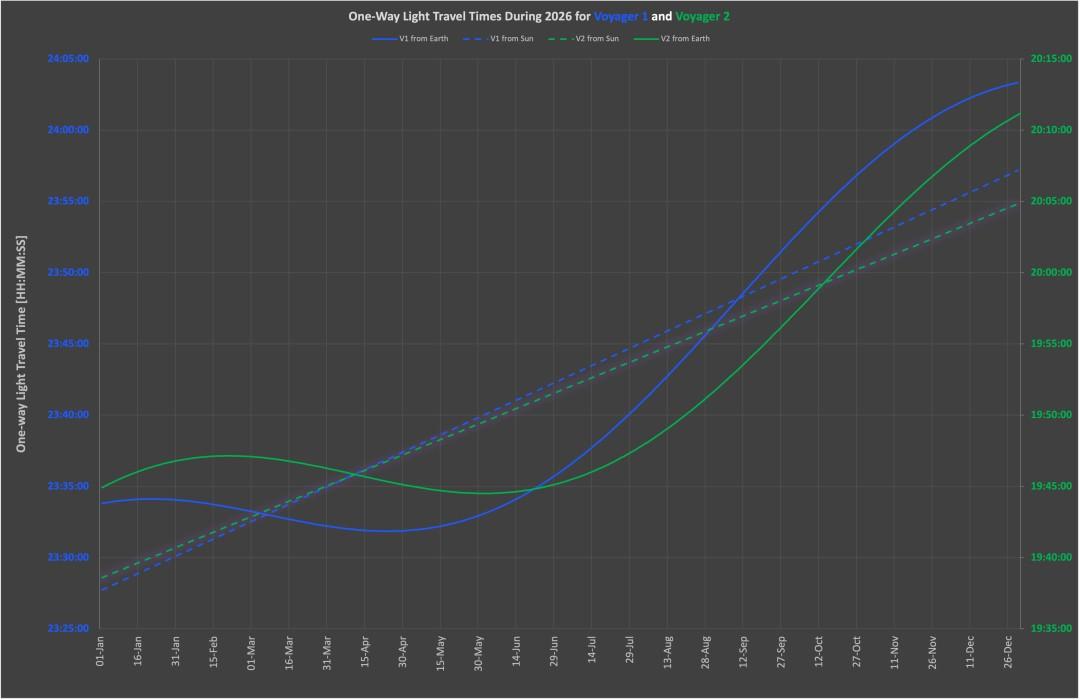
What about Voyager 2? V2 is traveling about 10% more slowly, and so is currently just over the 20 light-hour mark. This graph is more complicated than the last, but I thought this might interest those of you following our progress in detail. Here is a summary of all the One-Way Light Travel Times of the Voyager spacecraft over 2026. The first thing to note is that the plot lines have different vertical axes! While the times are _offset_ by 03H:50M, the intervals are the same. If you plot both these times on a _single_ vertical scale, you can barely see the sinusoidal shape. Remember: blue with blue (Voyager 1), and green with green (Voyager 2). OK, why is there this shape? 1/2
3 Boosts
1 Like


@NSFVoyager2 Very smug that I got the answer right :-)
I mean there should be a teeny 24-hour sinusoidal motion if you were measuring from where YOU are, but it's probably below the precision of the graph.

Because the distance measurements are being made from a moving platform: Earth. The sinusoidal variance is because of Earth's orbit around the Sun. At certain times of year, the Earth is moving towards the Voyagers faster than they are leaving, so the distance _decreases_. Why are they offset from each other? The Voyagers took very different paths out of the Solar System. V1 left after its Saturn encounter, while V2 chased down Uranus and Neptune, traveling farther around the ~plane of the planets' orbits, and that's why V2's interesting points are 'farther along in time.' We can also see that V1 is traveling faster than V2: it makes much more progress each year. Why? Because V2's last encounter (with Neptune), slowed it down significantly. The different angles involved between the spacecraft, the Earth, and the Sun are responsible for the precise shapes we see. Voyager 2 will reach the one light-day milestone just under nine years from now in 2035! #Voyager #OneLightYear 2/2