

I'm going to listen in to a talk by Prof. James Lowenthal from Smith College called "Darkness at Night: Essential for Health", for the IAU-CPS community education hub. I'll share some highlights (there aren't very many people here listening, which is crappy because James is such an excellent teacher!)
1 Boost
0 Likes
The difference in brightness between day and night used to be a factor of ~a million, now it's a factor of less than 1,000 because of light pollution and spending time indoors in daylight.
Cardiovascular disease, cancer, diabetes, obesity, sleep disruption, hormone imbalance, mood disorders, are all demonstrated to be caused or exacerbated by exposure to artificial light at night. Blue light is particularly bad.


"The difference in brightness between day and night used to be a factor of ~a million, now it's a factor of less than 1,000"
🤯 we broke night and day.
Only 20 years ago, scientists discovered we have a 3rd type of non-vision-related light receptors in our eyes: Intrinsically photosensitive retinal ganglion cells (what a mouthful... err... eyeful?) We also have a "chemical clock" in every cell nucleus that controls our circadian rhythm (2017 Nobel prize for this discovery!)
Robust circadian rhythms are important for good health. Exposure to blue light at night disrupts our circadian rhythms.
White LEDs are particularly bad with a "blue spike" that can suppress melatonin and disrupt our circadian rhythms. American Medical Association recommends against using blue-heavy LEDs.
Most vertebrates affected by this.
It's easy to fix lights so they don't cause as much light pollution: well pointed, redder lights are better! As you get older, you are more affected by glare from poorly aimed lights (including headlights).
Urban light pollution has gotten much worse every year: primarily due to LEDs. They are higher energy efficiency, so good! But overused because cheaper. US is wasting $3 billion per year on unnecessary lights.
Citizen science, you can report your sky here: https://globeatnight.org/

Bird migration happens at night (can see this on weather radar). Can see migration in N. America here: https://birdcast.org/. Bird migration routes worldwide are disrupted by light pollution, birds rely on stars to navigate (how will they be affected by megaconstellations 😭😭😭)
1 billion birds die in the US every year during migration due to light pollution.
Fish migration is also disrupted by artificial light, resulting in lower hatch rates.
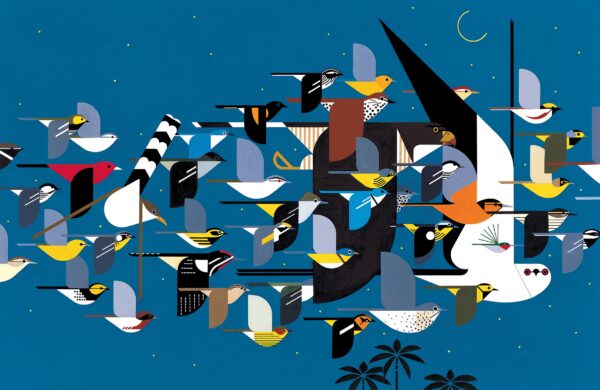
Blue light at night affects small mammals' foraging behaviour. Even seals use the stars to navigate. Fireflies need darkness. Streetlights along roadways dramatically reduce the number of insects present. Planting a pollinator garden is a great way to help moths/butterflies/bees, but even better is getting your town to turn off streetlights when not needed. Moths navigate by stars, too.
Biological responses across many species are VERY sensitive even to extremely faint artificial light.

Everyone wants to see the stars. Astrotourism is booming! Stargazing is a way to connect with our ancestors. There are well-documented, peer-reviewed health benefits to experiencing awe: reducing anxiety and stress, and one of the most reliable ways to experience awe is by looking at unpolluted night sky.
Light pollution is unwanted light: not being actively used, too much, poorly aimed.