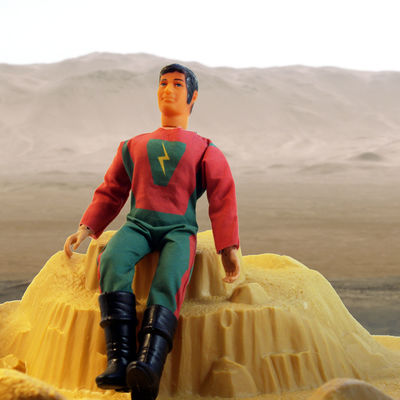

As I'm headed to Las Vegas for Designer Con, I am thinking about my experience in toy making.
When I got my start, as a kid, more than two decades ago, there was not a "designer toy" scene in the US. There were "folk art" toys, and "bootlegs", and "kitbashing."
Kitbashing is modifying commercially released toys. My dad and I would do this together, disassembling and repainting cheap abundant toys to create new characters, packaging them on white cardboard with hand drawn illustrations, and wrapping them in cling film to simulate a blister pack. I wish I had any of the one's of these I made as a child, or photos of them, but they're all long gone.
Folk art toys were traditional toys, blocks, dolls, rocking horses. They were made of wood, by craftsmen, or made of corn husks (I used to make a lot of corn husk dolls, after instructions in an old folk art book, and then decorate them like ninja turtles with crayola markers), or clay (I used to make clay out of flour and salt, following a recipe in an old folk art book. Cheap and easy, with ingredients that were abundant, and when it was baked off it was as hard as stone.)
I made a lot of folk art toys.
Bootlegs were usually made elsewhere in the world (until the late 00s, I'll get to that) and often blow molded out of very thin plastic, or cast in a very soft plastisol.
I loved these in the same way I love a Turkish action film like 3 Dev Adam. The juxtaposition of the familiar and the bizzare, the professional and the grotesque, is immensely appealing to me.
When I was a teenager casting rubbers and resins (and polymer clay! But I'll get to that later) hit the scene for consumers, and I started making my own bootlegs. Rubber molds of parts of existing action figures, cast in a two part resin and glued together. They were crude bootlegs, but they were also Mine.
And, with the right polymer clay, I could sculpt new parts and make a bunch of copies (sorta! Especially the resins that I could get my hands on in 2006 were expensive and tricky to get good results out of.)
But I wasn't a good sculptor, and some polymer clays inhibit the latex molds from curing properly and some of this stuff got pretty expensive, so often I was still just doing kitbash bootlegs, but in resin.
I didn't know it at the time, but there were lots of Serious Artists and also a bunch of other punks like me making similar resin bootlegs, and some of them were getting good at it. There were shows popping up across the country, and some of them made weird distinctions between what counted as art and what counted as plagerism (weird distinctions because they have no basis in law. Designer con used to be a soft vinyl only show (and soft vinyl, at the time, was an overseas factory only production) and looked down on resin casting. A lot of resin shows popped up explicitly celebrating bootleg and knockoff culture, but they looked down on 3D printing as cheating, and on factory made work as selling out.)
Even today, some of those divisions remain. East coast shows tend to be bootleg and knockoff shows, west coast shows tend to be all original and mostly factory made.

In that spirit, I took a couple of pictures of Kumiai-ki: the mighty labor union mech alongside an actual bootleg toy.
on the left in most of these photos is our 3.75" retro style robot toy, and on the right in most of these pictures is a late 90s blow molded power rangers bootleg (likely produced in Central America.)
The power ranger has a hole in his fist from the blow molding process. He's a solid piece, with no joints or articulation. He can't stand on his own, and he is a single solid color. He's about 5" tall.
Our littler man can stand on his own, can be posed, and is multicolored. It is obvious (to me at least) that the robot is the superior toy.