

Has the "ambiguous case" ever caused any "real-world" problems?
0 Boosts
0 Likes

@futurebird I can imagine it happening with things like decorative boxes made from pre-creased cardboard. Or folding chairs where there’s a diagonal brace that can be pinned at different positions depending on how much you want the back to recline. The brace will “fit” if you swing it the wrong way but may not work quite right.

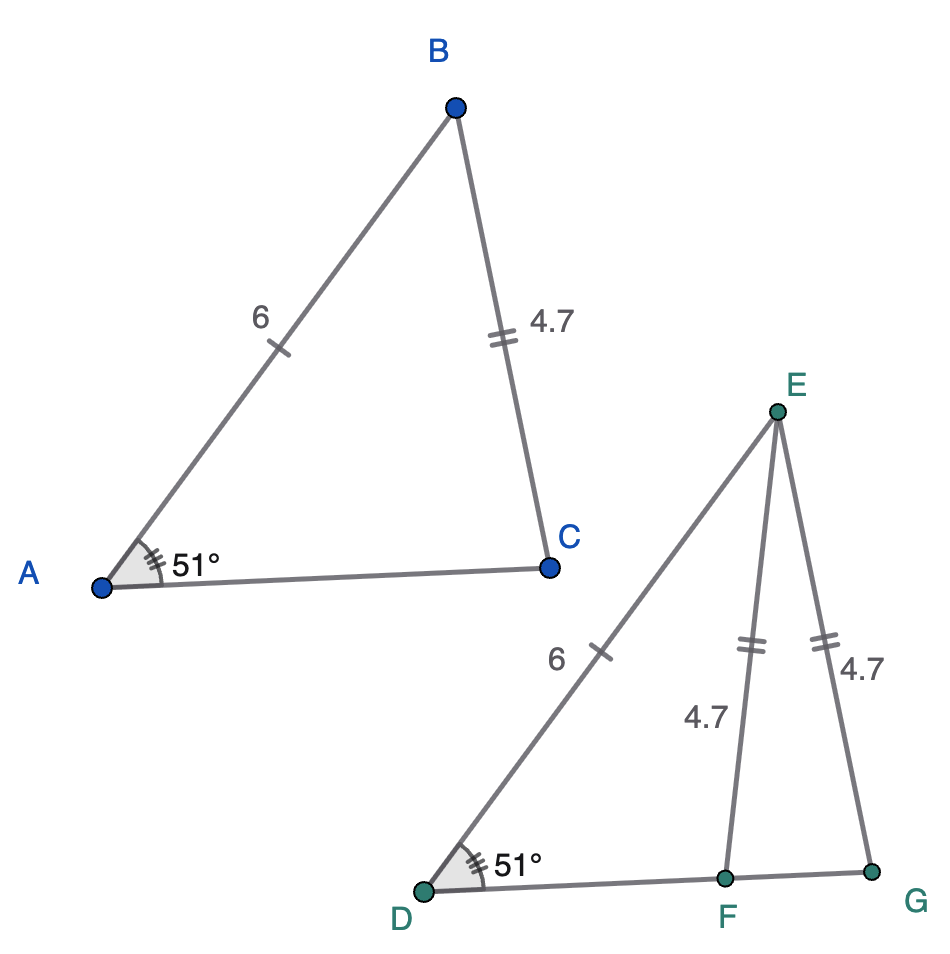
It's been a while that I've done maths but I don't see how EF could be equal both to EG and BC, without changing the 51° angle's value ?
If you slide BC to the right in the first figure, either the angle will change or C will leave the AC line (well, the original AC line I mean; C' won't be on the AC line, if you call C' the new position of C and keep the old one as C).


What is "the ambiguous case"?
As for real world, I suppose ship positions, or air traffic when the distance can be found by pinging?
It's when you describe a triangle using two side lengths and one angle, but due to the angle not being between the sides there is more than one possible triangle that fits the description.
Here is an example:


@futurebird I was recently thinking about this exact non-rule of congruence and couldn't remember why it doesn't work. I looked it up and was annoyed I hadn't figured it out.
The only way I can imagine real-world problems is if the information was communicated, both parties believed it was unambiguous, the receiver drew a different triangle than the sender intended, and the error was not obvious from context ("there must be some mistake, an obtuse triangle doesn't work here").

@futurebird Not knowing what the question is doesn't help.
The question I'm asking or...?


@futurebird Fun question. I doubt it. The problems leading to it have the sort of limited set of restrictions you don't get in the real world.
Unless you count "I made a program to solve this problem and it gets wrong answers" 'real world'. In which case probably.
I could see it happening in 3D rendering if you assumed that you would have the same triangle with the wrong set of information.
@futurebird @btuftin yeah, 3D rendering is the case I thought of first.
@futurebird @llewelly @btuftin Ooh, in that case I don't know if it's something that has happened in real life, but I can imagine it being a plot point in a nerdy mystery story. I guess that's another way of saying "a little word problem", except it would be a more elaborate word problem.

@futurebird MAGRITTE: ∠ACB n’est pas aigu