
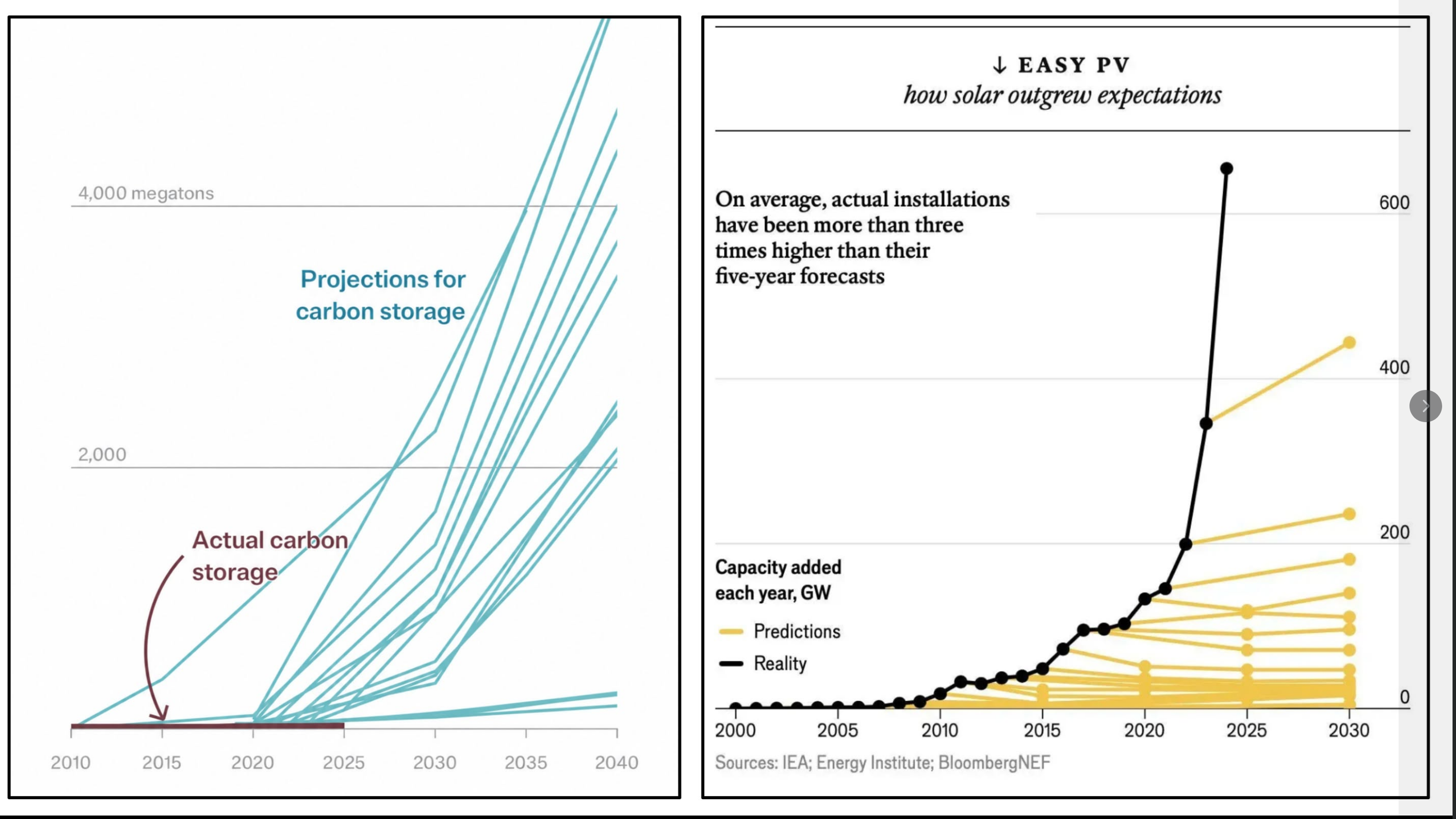
"Carbon capture" is clearly nonsense. Solar is clearly not.
2 Boosts
1 Like
@th Very specifically, yes.
People championing nuclear are also lost in the weeds of basic math. Nuclear energy costs between $0.0045 and $0.0060 /kWh, but that's only fuel costs; it doesn't include the $5b-$10b best case for a five-year-minimum reactor buildout.
If you want the $0.08 to $0.15 energy solar provides _including_ build costs, you can have huge installations for a few million in months, and home installations for thousands in weeks.
https://world-nuclear.org/information-library/economic-aspects/economics-of-nuclear-power
https://solarcalculatorcanada.org/solar-panel-cost-canada
https://liberalandlovingit.substack.com/p/cost-analysis-of-a-nuclear-power
The reason all of this continues to be interesting to me is that solar power fundamentally changes the power dynamics of the state.
The classic definition of The State is an organization with a monopoly on the use of violence within its borders. A societal dependency on supply chains - the power grid, the oil industry - that can be cut off at will is one of and maybe the foremost levers of that violence, more so than police or the military.
Solar+batteries changes that entire relationship.


@mhoye I used to be pro-nuclear, but with the time delay and the upfront investment, wind and solar wins every single time, especially with the rate that the technology is improving. By the time we've managed to even draw up plans for nuclear, solar, wind, and battery tech would have leapfrogged the old tech again.
I point back to "Do Artifacts Have Politics?" (https://faculty.cc.gatech.edu/~beki/cs4001/Winner.pdf) Most of us can afford a solar panel. But these huge electrical infrastructure projects centralize power in these often private corporate interests, be they construction contractors, operators, nuclear IP... etc. Control over electrical power is power over people.


@mayintoronto @mhoye I'm a supporter of a "small is beautiful" decentralized approaches to technology.
But then, I come out of the amateur (ham) radio world where "small is beautiful" has been the technological approach for a century.
I recall a story of a bad hurricane that ripped through Cuba years ago knocking everything off line in western Pinar del Rio province. The sole communication link to Havana was a teenage ham radio operator powering his equipment from a car battery.
@mayintoronto @mhoye During the 1998 ice storm in eastern Ontario, local ham radio operators pitched in because in many instances they had a more functional communications system in rural Eastern Ontario than the Canadian forces had.

@leftylabourtech @mayintoronto @mhoye Which is friggin' embarassing...
@ZenHeathen @mayintoronto @mhoye It's about building in redundancy.
The assorted ham radio clubs already had networks of linked VHF/UHF repeaters that they normally just used for fun as nerd projects and to engage in idle chit chat on with their friends.
Some stuff would be up, some down because of ice damage, but in the main, it all worked. The CAF would have to move stuff into the area for communications purposes. For the ham radio folks it was already there.
@ZenHeathen @mayintoronto @mhoye I helped staff the HF link to eastern Ontario via the ham radio station VE3EMO at Emergency Measures Ontario for a couple of days.
It wasn't really needed much, but there were always three or four ham radio volunteers there "just in case".
I got a thank you letter from the Minister for my service, the only thank you letter I've ever received from a Tory. LOL!!!

I don't know why you are phrasing this like the state won't use violence to maintain control of energy supply chains

@mhoye there's very strong Itanium sales forecast energy in that first chart