
0 Boosts
0 Likes
Every use case has an appropriate tool. Idk what the Raspi version is doing, but at least on Desktop & Server Version it’s possible to add the backports repo. And in my case i also have the nvidia repo too. The version there is literally the same as in *buntu. For everything else Flatpak, Snap & AppImage exists.

No, snap does not exist
I haven’t checked for RPI specifically, but those are usually configuration issues. Either put your user into the relevant group, or chown the pins into something usable. They should be exposed in /dev or /sys
Keep your life exciting by deploying an internet-facing service on Arch!
Actually, I formed my opinion on watching debian take forever to install on a PC while every other distro installed 300x faster, and then watching it not run correctly because it didn’t support the hardware.
It probably has improved since then, but why would I bother trying again?
Use whatever works best for you. That’s the beauty of Linux.
Indeed. But it seems it personally offends some people when you tell them their pet distro actually sucked ass on your hardware. As if arguing is going to make it run better.
It sounds like you are the one who is offended, like you have a chip on your shoulder or a grudge against the most ordinary, bland, but reliable distro. It’s really weird, to be honest. It’s like being offended by people drinking water instead of your preferred beverage.
No you can’t do that, you have to use what i am using, that’s the only correct distro which everyone should be using

I actually kinda wonder if my issues with Linux as a daily driver and not just for my server stuff was because I was always chasing the bleeding edge. I don’t want my PC just to work, I like doing rad shit with it.
Then again, I first used Linux in 1993 (Slackware). Everything about it was bleeding edge.

I actually kinda wonder if my issues with Linux as a daily driver and not just for my server stuff was because I was always chasing the bleeding edge.
It’s actually more simple than the way people usually explain it.
Each distro is made of thousands of components. Their interoperability needs to be thoroughly tested and the versions of the software need to be stabilised.
Debian’s slow and steady release cycles not only do this, but make a guarantee that if the OS works on your system on release day, the OS will continue working there until the LTS window closes.
With faster release cycles, the interoperability and stability of the software is replaced with more up to date software without that kind of guarantee, and due to deprecations happening and being accepted, this further decays stability.
Recent examples that personally WOULD have affected me include KDEs X11 deprecation, and NVidia removing compatibility for my graphics card from their driver.


Yup. Linux really ceased having issues for me when I started using Ubuntu LTS around 2014-15. In fact my main machine hasn’t been reinstalled since then.
Crazy when you start using LTS versions of software and that software… works.


Debian is pretty reliable, which is why I used it on my old home server. But the current one is fedora because debian on aarch64 mac hardware is not a very well supported usecase and what’s most important for me is a solid and supported base
How’s the experience of Linux on Mac Arm? I’ve been eyeing a used M2 or M3 laptop but I’ve heard a lot of functionality isn’t there yet.
Debian Unstable works great, it’s not perfect tho

Debian for servers but never for main
this is the way.
Fuck omarchy. Fascist distro aside, the “I use arch btw”, but actually omarchy crowd is disgusting.
Fedora has been surprisingly smooth.


I don’t mean this in seriousness, as I agree with your assessment of Omarchy, but you can create a conspiracy style graph of:
Fedora -> Red Hat -> IBM -> Nazi Germany
Again, I don’t mean this to imply this is the same as Omarchy, or even to take this seriously (as Red Hat was acquired by IBM only a few years ago). Also, Omarchy is basically:
Omarchy -> White Supremacy
What even is your point then if no one should take it seriously?

And even without the fascism, having like 20+ agents on your system sounds like a nightmare. Even if you like AI i just don’t understand why on earth you’d want your OS to be that bloated up.
I like Debian. Debian was my first choice when I built a new computer in 2025… only to find out that hardware can be too new for Debian.
I eventually landed on Linux Mint but I still choose LMDE for my laptops, for the stability combined with familiarity. I just have to lean on flatpak a little more than usual.
Mint is incredible
99.999% of the time it’s just outdated GPU drivers which causes the problem.
oh noooo, it was far more than that.
I bought an Intel Arc A580 as the GPU. Debian Bookworm (the latest in early 2025) predated the A580 by four months. The drivers weren’t outdated… They just didn’t exist.
The onboard ethernet and audio drivers also didn’t properly run. Had to compile them by hand by using chipset info. I vaguely recall having to hack together a startup script that would recompile and reinstall them everytime the kernel updated.
It all came crashing down when my NVME stopped being recognized on reboot. No idea what the cause there was. Maybe a mobo chipset incompatibility? Again, the mobo was newer than Debian Bookworm by a full year, so very likely.


The inter-distro drama is really quite funny. The vast majority of Linux distros are, in fact, systemd distros. They use the same kernel, libc, userland, boot manager, etc. Some components and defaults are different, KDE over Gnome or Zsh over Bash, but really the only meaningful difference between Arch and Mint is the package management philosophy. There are some truly unique distros with fairly substantial differences in both philosophy and technology I love recommending. My two favorites are Nura (formerly PostmarketOS) and Chimera Linux with KaOS as an honorable mention. But these are such small and niche projects that no one really argues over them, it’s more about the very similar Mint VS Arch. So why the fuck do Linux users argue over them? There’s reasons for both, so why not argue over something productive like text editors? But not omarchy, fuck whoever is the “dev” of the project.
Sometimes I wonder how many of these people are actually engineers/developers vs people who learned how to use a particular distro very well, and they don’t like how they can’t adopt other distros easily.
I think we can all say “fuck omarchy” and agree on that though.
It’s also understandable. The way these beginner friendly sites for teaching Linux and technology are worded (Geeks for Geeks, Baeldung, etc.), they make it sound like there is some massive difference between distros. The way these sites tend to present information is unfortunate. I sometimes use them to figure out broadly what commands can be used for a task or maybe simple script syntax, but they are by no means a substitute for reading the manual. I’m also not saying there is not a place for these kinds of sites; most people don’t want to understand how the machine works. What is the problem is that they present themselves as though they are teaching how the machine works, when they aren’t even the tip of the iceberg.
My undergrad was in electrical and computer - I don’t think that touched the tip of the iceberg.
Yeah, your right. I always love blowing peoples’ minds explaining microcode. Computers are… strange.
How about this for fueling the fire:
I like Bazzite and Ubuntu? I like Rasberry Pi OS, and I like Steam OS. I use Redhat/Fedora Linux at work. Actually, my OS at work is Windows, and I have to work with engineers that use Apple machines. If they don’t use docker/podman, guess how much of a nightmare that can be?
And know what? I think everyone who rigorously sticks to and argues for a particular Linux distro is in their right to, but ultimately behaving detrimentally to the Open Source community.
The whole fucking point of different distros is different ways of doing things. Otherwise y’all would be no different than MacOS or Windows.
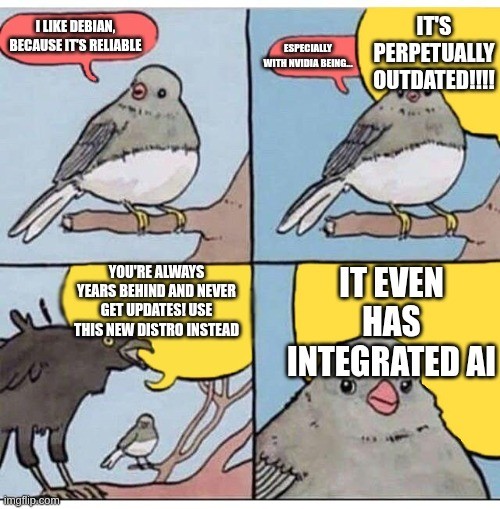
“I use arch btw” is a meme. Don’t be like that. Leave Debian alone. Debian is good at what it does.
Couldn’t agree more, mate.


The bestblinux distro is the one that you’re used to. Can’t imagine going to the effort of installing a whole new distro just because I’m bored of Mint

Unless it’s Ubuntu, of course.

I’m bored of Mint
“Beginner” distros are where its at
I just want it to work, and Mint does. It just works.
The best linux distro is the one that you’re used to.
This is my take on programming languages. For me, the best language is the one with which I am the most familiar. Me at my Visual Basic peak could code rings around the me that was first learning Objective-C (if you ignore the fact that there was never a way to write iOS apps in Visual Basic).

Not what a strawman is. This dip shit probably sniffs chairs, their argument is invalid.
See, that’s a strawman. The meme is just describing an annoying person and you took personal offense to that for some reason.
Not what a strawman is. This dip shit probably sniffs chairs, their argument is invalid.
No you just described an ad hominem. Don’t correct people when you don’t know what you’re talking about.
I mean, it only matters if you have a recurring issue.
If you don’t, it ain’t broke.
If you are fighting your distro over a particular issue, though, that’s not good. There are definitely people in that category that should probably be informed they can switch.
Debian is amazing. I’d use Fedora if you want more cutting edge stuff. Arch if you know what you’re doing and want the latest of anything.
Personally, I don’t game very much, so Debian suits my needs. It’s rock solid.
Agreed. My community needs something stable for our infrastructure, so we go with Debian.
Debian is great and is what I use at work. I’ve been using the same install for years without issue.
I just tried Arch on my PC but found I spent two hours out of the gate working on glitches in some of my must-have software. I realized I didn’t want that to be my life, so switched to Fedora. It’s a similar user experience but everything instead just works.

For a project using Elixir on a Raspberry Pi I recently used Alpine instead of the default Raspberry OS because the package there was so old that it wasn’t compatible with a second PC I was developing the project on. It could have worked if I had set up a special distrobox with Debian or something that has the older version but honestly why do all that just for using software that’s years old. However now I have to run the project as root because apparently you can’t access the GPIO pins as a user on anything other than Raspberry OS so it’s not perfect but at least it works.