

Is there a way to disable `su` on a Linux machine? Or apparmor an entire account so that it cannot `su`
0 Boosts
0 Likes
Hm
https://www.tecmint.com/disable-su-access-sudo-users/
But this only appears to disable su root. There seems to also be a way to do this with PAM but also that might only disable su root.
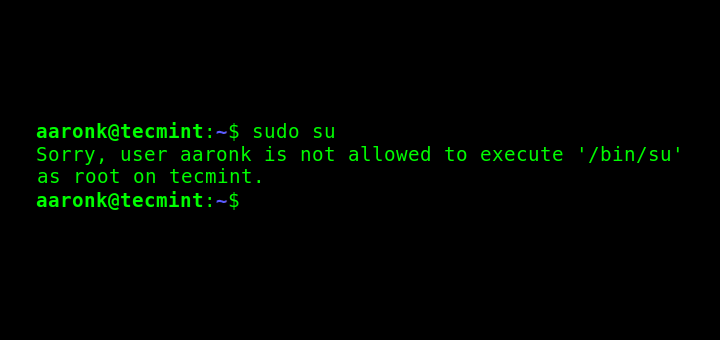

@mcc i think that technically only disables "sudo su", not regular "su"?

@ratsnakegames @mcc yeah, I was going to suggest that also. This is specifically disabling the path where you can run `sudo su` and type in the password of the current user (as opposed to `root`'s password) in order to execute su.
@lambdageek @ratsnakegames 😞 oh. DISABLE_SU made it sound like it disables su :(
@mcc @lambdageek nah, that's just an arbitrary alias for a specific command, it might as well be named "SPAWN_DINOSAURS"


@mcc I'll take this into account for my "Advanced shell: remote access and session multiplexing" tutorials. I'm trying to have a sandbox (virtual) machine for them to donexercices CTF-style.

@mcc if I have `sudo`, I don't need `su`:
`sudo -i` is sufficient to get a shell as root. `sudo su` is not required.
IMHO: If you don't want others to become root, revoke their sudo privs and set a root password.
@anton but i can prevent someone from sudoing by not putting them in sudoers, right? also i didn't mention root


@mcc just did this the other day! You can do it with PAM:
auth required pam_wheel.so use_uid deny group=(probably sudo but you could do all)
has to go in the pam.d config before the password auth rules.


@mcc I know a number of admins who remove su and disallow root logins because well-constrained sudoers is safer and has much better logging.


@mcc chmod 0000 /bin/su
@grumpybozo hm, would that prevent you from doing whatever the C equivalent of su is? or is there no C equivalent
@mcc Well, su is written in C so having C rely on the compiled binary would make no sense. There’s a standard C syscall: setuid().
An attacker could not reverse that chmod because the 4th zero removes the setuid bit on the su binary.
@grumpybozo I guess the question is, does su work because it calls a linux syscall that does a su-like thing, or does it work because the su executable is setuid root
@mcc mayebe dpkg-statoverride to remove the setuid bit (and maybe also the executable bits for good measure)?
This is morally equivalent to the various folks suggesting deleting or chmodding `su` but in a way that will survive util-linux updates.
note: I'm kind of guessing, haven't tried it.



@mcc wait are *accounts* a thing you can apparmor? I thought it worked on executables. (in fairness I am not particularly clear on what it does other than breaking file-selection dialog boxes sometimes)
@mcc why not go to the nuclear option and 'sudo rm -i $(which su)'?


@mcc Sure. /etc/pam.d/su and /etc/pam.d/su-l contain the authentication policies for su.
su on Linux does not require a user to be in the 'wheel' group. You can use pam_wheel to add that requirement and get a win in security without any risk. First, add yourself to the wheel group with: usermod -a -G wheel mcc.
I personally set PAM to additionally require a Security Key keypress, using pam_u2f with userpresence=1 for login, su, sudo and so on.
You could have a policy for su such as pam_warn (syslog message) followed by pam_deny. You could trial that with just pam_warn and see if that produces log messages in the ordinary operation of the computer.

@mcc Linux has the PR_SET_NO_NEW_PRIVS process control flag that will prevent a process or its descendants from gaining privileges by executing setuid binaries.
You can have it applied to the login sessions of a particular user via /etc/security/limits.conf (search for nonewprivs in the limits.conf man page).

It seems like in an environment where sudo exists `su` exists only for RCE'd servers to call it