

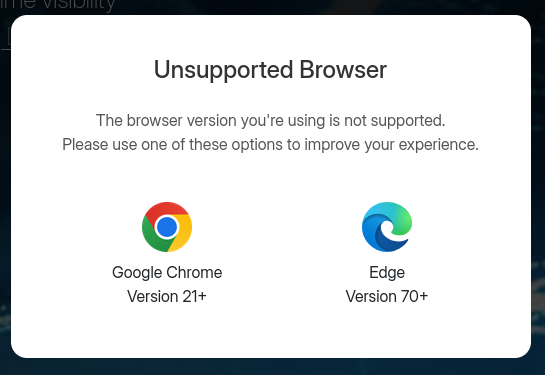
We're back to the "you must use Internet Explorer 6 to view this page" experience of the internet again, I see.
5 Boosts
0 Likes


@vwbusguy I don't have an account to test this, but FWIW, these #uBlockOrigin filters may suffice:
idplogin.gep.com###unsupportedModal
idplogin.gep.com##body:style(overflow: auto !important)
If not, spoofing a Chrome or Edge user-agent string in addition would be my next thing to try.
@deFractal Yeah, I spoofed chrome in the Firefox Dev tools and it loads


@vwbusguy The US Copyright Office has HTML so out of date they recommend Firefox. Everything old is new again.
"NOTE: The eCO System has been confirmed for use with the Firefox browser on the Microsoft Operating system.
Other browsers such as Internet Explorer, Chrome and Safari (as well as out-of-date browsers) may work but potentially could show
less than optimal behavior when used with the eCO System."
https://eservice.eco.loc.gov/siebel/app/eservice/enu?SWECmd=Start
@garretpolk It supports Firefox on Xenix?!


I remember when AT&T wl joined up with Microsoft so only Internet Explorer could be used to configure their equipment ☠️
@dianea I remember that, too! A tech told me holding down shift when clicking bypassed that check and it worked for me back in 2006 setting up DSL with Firefox on Fedora Core 6.


@vwbusguy This is why iPhone only supporting Webkit is basically a vital/load-bearing structure for the Internet. The sole thing holding back a Chrome monopoly is that web developers have to support iPhones, and hence, must develop to standards.
This is also why that "Open Web Advocacy" outfit is so incredibly dangerous.


iOS is by far the most valuable computing platform there is, which means two things:
- If Firefox can bring Gecko - outcompeting Safari and winning marketshare, it can significantly increase its resources and improve its engine faster. Firefox has already doubled in iOS daily users in the EU due to the DMA choice screens which we pushed hard for (https://blog.mozilla.org/en/mozilla/internet-policy/apple-ios-browser-engine-rules/).
- Apple aren't just going to let Google take their users and money. Apple is probably the only organisation at the moment with the resources and market position to seriously take on Chromium. They could 10x Safari's budget tomorrow without breaking a sweat, and even port it over to Windows and Android like they used to. That they don't is a deliberate choice to hold back the web. But in the past 5 or so years - since regulators have been investigating - the headcount has already been roughly doubled, and Safari is bit by bit catching up with Firefox and Chrome. That's what we want! A competitive browser engine market which pushes the whole web forward, rather than one where Apple has a chokehold over which features can be used, and which are reserved for their native app ecosystem.

To be clear, we don't like it when *any* company acts anti-competitively, whether that's Apple, Microsoft, Google or someone else. Earlier in the year I helped write this response to the CMA's investigation into Microsoft's business practices, where we outlined both Microsoft and Google's anti-competivie behaviour with browsers, which absolutely need fixing:
https://www.gov.uk/government/calls-for-evidence/microsofts-business-software-ecosystem-invitation-to-comment
We've also pushed hard to improve choice screens on Android:
https://open-web-advocacy.org/blog/google-backs-down--will-grant-hotseat-in-eu-browser-choice-screen/
And to open up Android's WebAPK minting to third party browsers:
https://open-web-advocacy.org/blog/google-must-share-the-ability-to-install-web-apps-in-android/
https://issuetracker.google.com/u/0/issues/543049061
In all 3 cases (Windows/Edge, Android choice screens, WebAPK minting) we've improved things, even if they're not yet as good as they could be.

@FormularSumo @vwbusguy There are legitimate and non-legitimate complaints about Apple. The reason a lot of Google's proprietary web APIs aren't standard is because in a lot of cases the other vendors have actively rejected them as dangerous.
But the key thing is allowing alternative engines on iOS would cost the open web the entire ball game. Screens like the above would become massively more common.
@FormularSumo @vwbusguy And anyone who is part of OWA most certainly *knows that* at some level. So if they aren't actively opposing alternative browsers on iOS, they are taking a position in favor of moving complete control of the web platform to Google, and ensuring developers no longer have any incentive to build on standards or to the lowest common denominator.
There definitely are cases where Google's proposed APIs are bad for the web. The failed web integrity one comes to mind (though I would note that Safari already added something very similar without much fanfare - https://httptoolkit.com/blog/apple-private-access-tokens-attestation/). Flock would be another. Both were rejected by other engines and by other Chromium-based browsers.
Yet the overwhelming majority of APIs coming out of Chromium haven't been implemented in Gecko or WebKit simply because they lack the resources to keep up. Gecko because it's run by a small non-profit that's been squeezed out by anti-competitive practices (as noted in in the Microsoft paper, but also by Apple's browser ban), and WebKit because Apple significantly underfunds it, to the point of being consistently outperformed by Mozilla.
The evidence is clear to see. Safari launches non-controversial features without any changes years after other engines, often half-implemented and broken. That's not rejecting or coming up with better designs. You can find a good overview of this here: https://infrequently.org/2025/09/cupertinos-comforting-myths/
@FormularSumo @vwbusguy WebSerial, WebHID, WebMIDI, etc. etc. etc. There are dozens of Chrome APIs which are both actively harmful to security and privacy and which are implemented, frankly, for tech nerds, and consider the safety of ordinary users an acceptable compromise for technologist convenience.
But this is beside the point: The only way to ensure the open web survives is to ensure developers cannot solely target Chrome. Your group exists to remove that check.
@FormularSumo @vwbusguy The fact that you are sharring Alex Russell's blog exemplifies the point that OWA is a shill outfit with a primary goal of enhancing Chromium's monopoly at the expense of the open web. He is not a neutral actor, and as far as OWA continues to promote his writing, OWA should be considered a tech industry astroturfing outfit.
WebMIDI and WebSerial are both in Firefox now, which many people were very happy about. https://hacks.mozilla.org/2026/05/web-serial-support-in-firefox/
The key thing is that the web is currently being squeezed out of mobile and new form factors. Desktop computers and laptops are a shrinking part of how the world goes online. If the open web is to have a future, it *needs* to be able to compete on mobile devices. Otherwise it'll just survive as a legacy system where people spend less and less time.
@FormularSumo @vwbusguy Advocate for the open web then! Not for a Chromium monopoly. Open your eyes. Look at what the end goal of OWA's advocacy is. It's what's at the top of this thread. On every web page.
Look, you're a student. Some of us have been here when IE-as-a-requirement existed. We know how this works, we've seen it happen, and we're starting to see it again.
@FormularSumo @vwbusguy If you want to advocate for the open web, advocate for a prohibition on Google introducing new specifications, and advocate for governments to prohibit providers from requiring them to access their websites. As a monopolist which has been found to be violating the law in nearly every country that *has laws*, advocate for Google to be relegated to advisory-only positions in standards groups and prohibited from leading them.
I think I've described OWA's end goal accurately. Real browser engine competition, where Safari is leading edge browser that users and developers want to use, rather than a trailing one. Why don't you believe that Apple is capable of doing that, once the incentives are fixed?
@FormularSumo @vwbusguy One, as soon as Chromium exists on iOS, it stops mattering, because developers will apply the screens above. If you truly believe what you claim, you're just misled.
But second, that presumes that all of Chrome's insanely niche and risky APIs are good or necessary or important for a leading browser to have. And that's a perspective you get from reading people like Alex Russell, not interacting with real web users.
I've spent 9 years using Firefox, so I'm very aware of the website compatibility problems. I've looked into and reported many of them, and there's a mixture of web developers choosing not to support, and features genuinely not being available or complete.
Look, I understand why you don't like Google. I don't like big tech companies controlling so much of our lives, whether that is Google, Microsoft, or Apple. But you really need to look at what the end-game is of the status quo. It's not an open web, it's a web that's become irrelvant because Apple (and Google) have chosen that. And then we really are trapped in their proprietary ecosystems. Look at Apple's incentives and why it is that everything is leading to the App Store model. It's grossly anti-competitive and the polar opposite of being open. I want the web to suceed, and I hope you'll come round to that once you've seen the effects of improving competition, market structures and incentives for these companies.
@FormularSumo @vwbusguy We are at exactly zero risk of the web becoming irrelevant. I think you've been steered far astray in understanding the risks involved.
The biggest risk to the open web is Google. The way that risk is exemplified is in their ability to close or proprietarize the web. And most of the posts at the top of your profile are actively campaigning to allow Chrome in the one place currently protected from it going.
You are actively harming the web, and you are a danger to it.

"Best viewed in 800x600"

@vwbusguy this deserves a name-and-shame.